At Sun Process Converting, we bring more than 50 years of experience in contract converting, coating, laminating, and precision material processing. We work with OEMs, manufacturers, and industrial suppliers to transform raw materials into production ready components that meet specific application requirements. Our capabilities include contract coating, custom coatings, slitting, sheeting, die cutting, and laminating, supported by ISO 9001:2015 quality standards.
For businesses that manufacture or source coated and converted materials, understanding chemical regulations is an important part of product development and supply chain management. California Proposition 65 and the European Union’s REACH regulation establish different requirements for chemical exposure, product safety, and supply chain communication. Understanding these regulations helps businesses evaluate materials and prepare products for their intended markets.
What Is Prop 65?
California Proposition 65, officially known as the Safe Drinking Water and Toxic Enforcement Act of 1986, requires businesses to provide clear and reasonable warnings before exposing people in California to chemicals listed as causing cancer or reproductive harm, unless an applicable exemption or exposure threshold applies.
For manufacturers working with adhesives, films, coatings, and laminates, evaluating chemical content and potential exposure can help determine whether a warning is necessary. A product containing a listed chemical does not automatically require a warning. Businesses must consider the type and level of exposure and applicable safe harbor levels.
Manufacturers and suppliers should review material information, evaluate potential exposure scenarios, and communicate relevant compliance information throughout the supply chain.
What Is REACH?
REACH stands for Registration, Evaluation, Authorisation and Restriction of Chemicals. This European Union regulation addresses the risks associated with chemical substances and establishes obligations for businesses that manufacture, import, or use chemicals and products in the EU market.
REACH requirements depend on the substance and how it is supplied or used. Businesses may need to assess substance registration obligations, applicable restrictions, authorisation requirements, and communication duties involving Substances of Very High Concern (SVHCs).
For articles such as coated films and laminated materials, businesses should check the current REACH Candidate List and determine whether relevant SVHCs are present. If an article contains a Candidate List SVHC above 0.1% by weight, specific supply chain communication obligations generally apply. Additional notification and other requirements may also be relevant.
Key Differences
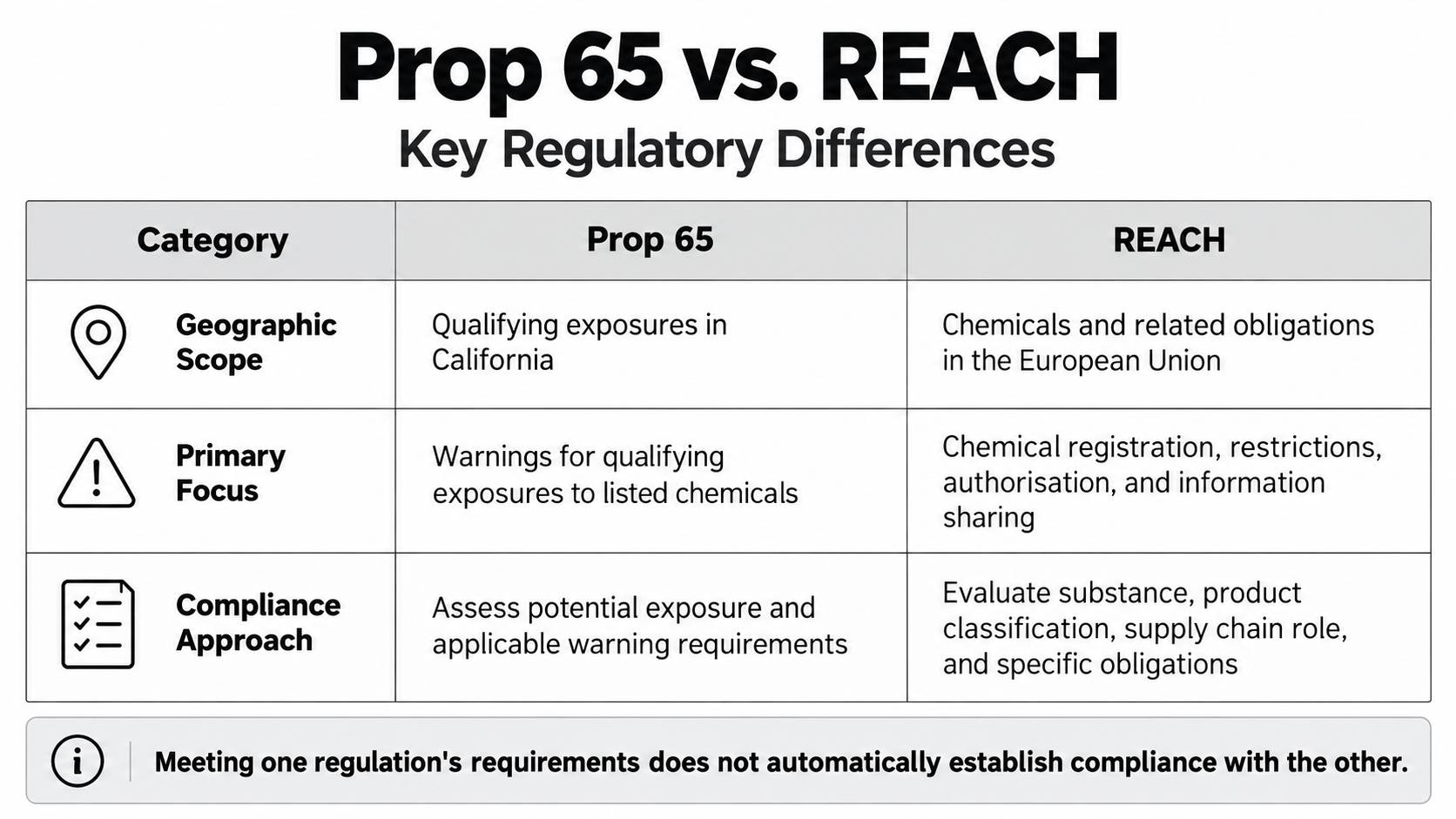
Although both regulations address chemical-related concerns, Prop 65 and REACH serve different purposes.
- Geographic scope: Prop 65 applies to qualifying exposures in California, while REACH primarily governs chemicals and related obligations in the European Union.
- Primary focus: Prop 65 centers on warnings for qualifying exposures to listed chemicals. REACH addresses chemical registration, restrictions, authorisation, and information sharing.
- Compliance approach: Prop 65 requires an assessment of potential exposure and applicable warning requirements. REACH compliance depends on the substance, product classification, supply chain role, and specific regulatory obligations.
Meeting one regulation’s requirements does not automatically establish compliance with the other.
Compliance Steps for Businesses
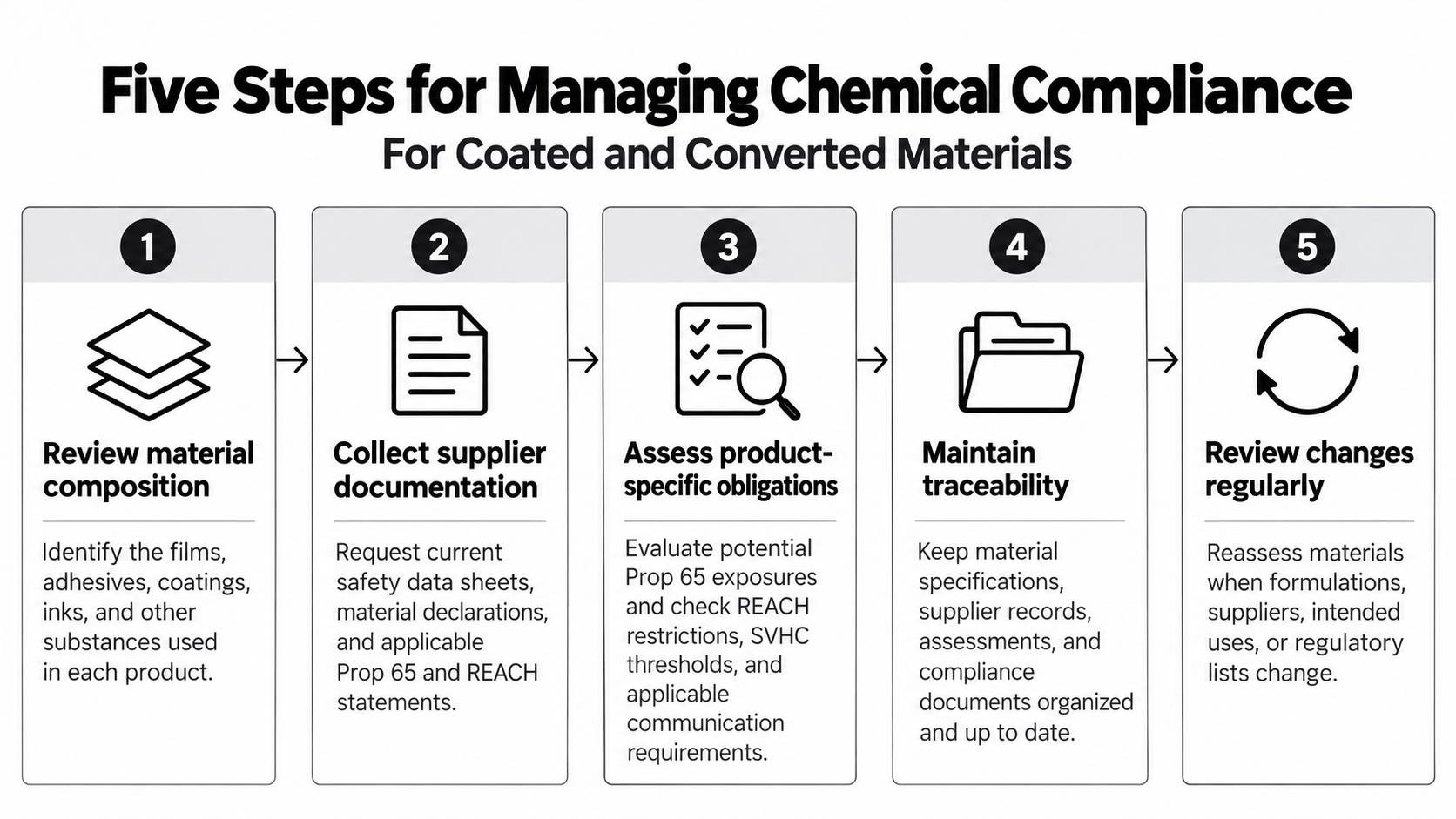
Businesses can take several practical steps to manage chemical compliance:
- Review material composition. Identify the films, adhesives, coatings, inks, and other substances used in each product.
- Collect supplier documentation. Request current safety data sheets, material declarations, and applicable Prop 65 and REACH statements.
- Assess product specific obligations. Evaluate potential Prop 65 exposures and check REACH restrictions, SVHC thresholds, and applicable communication requirements.
- Maintain traceability. Keep material specifications, supplier records, assessments, and compliance documents organized and up to date.
- Review changes regularly. Reassess materials when formulations, suppliers, intended uses, or regulatory lists change.
Working with an experienced contract coating and toll coating provider can also help businesses coordinate material specifications and manufacturing requirements. However, compliance responsibilities should be clearly established across the supply chain.
Partner With Sun Process Converting
Sun Process Converting supports manufacturers with custom coatings, contract coating, toll coating, laminating, and precision converting services. Contact our team to discuss your material requirements, application specifications, and documentation needs. We can work with you to understand your project requirements and identify the information needed to support your product compliance process.
Frequently Asked Questions
Can Sun Process apply coatings to customer supplied materials?
Yes. Sun Process can coat and convert customer supplied materials, allowing businesses to work with their existing substrates and evaluate material specific compliance requirements.
What types of coating processes does Sun Process offer?
Sun Process offers adhesive, barrier, top, pressure sensitive, one-sided, and two-sided coating services. These options allow manufacturers to select processes based on their product requirements and material specifications.
Can Sun Process help develop or test coating formulations?
Yes. Sun Process offers pilot coating services to support adhesive formulation work, product prototyping, and formula adjustments before moving toward production.
Does ISO 9001:2015 certification guarantee Prop 65 or REACH compliance?
No. ISO 9001:2015 certification relates to quality management systems and does not, by itself, establish compliance with Prop 65 or REACH. Product specific chemical assessments and applicable documentation are still necessary.